These free guides, resources on native plant gardens will help birds
Save the Dunes, Wild Ones help you to fill critical gaps for birds. And famed expert Doug Tallamy returns to talk.

Birds big and small are on the move in our area. Eagle eggs have been laid in their nest. And that will bring me to some newly published, detailed guides for what you can plant this spring to help birds. Plus other resources.
I saw and heard a nice V formation of sandhill cranes, more than a couple dozen, flying high over my South Bend neighborhood last Friday. Other locals have also witnessed flocks of cranes, too.
Hikers just recently spied pelicans in Worster Lake at Potato Creek State Park in North Liberty — part of the pelicans’ annual migration. They’ve consistently made Potato Creek a way station for a few weeks each spring.
Red-winged blackbirds are indeed back, among the first returning migrants.
American robins are bob-bob-bobbin’ around. Some of them stay through the winter where they can find food. But extra robins are now showing up, likely new arrivals.
Notably, though, the eagles in the nest at St. Patrick’s County Park have laid three eggs, their usual limit. The first one broke, which happens in nature, and the adults have removed it from the nest. But the two other eggs seem to be doing well. I’d alerted you to the egg laying just before it began in my Feb. 19 blog.
And, although they are known as whistle pigs, not flying pigs, ye ol’ groundhogs have just started to emerge from their holes. How many more weeks of spring?
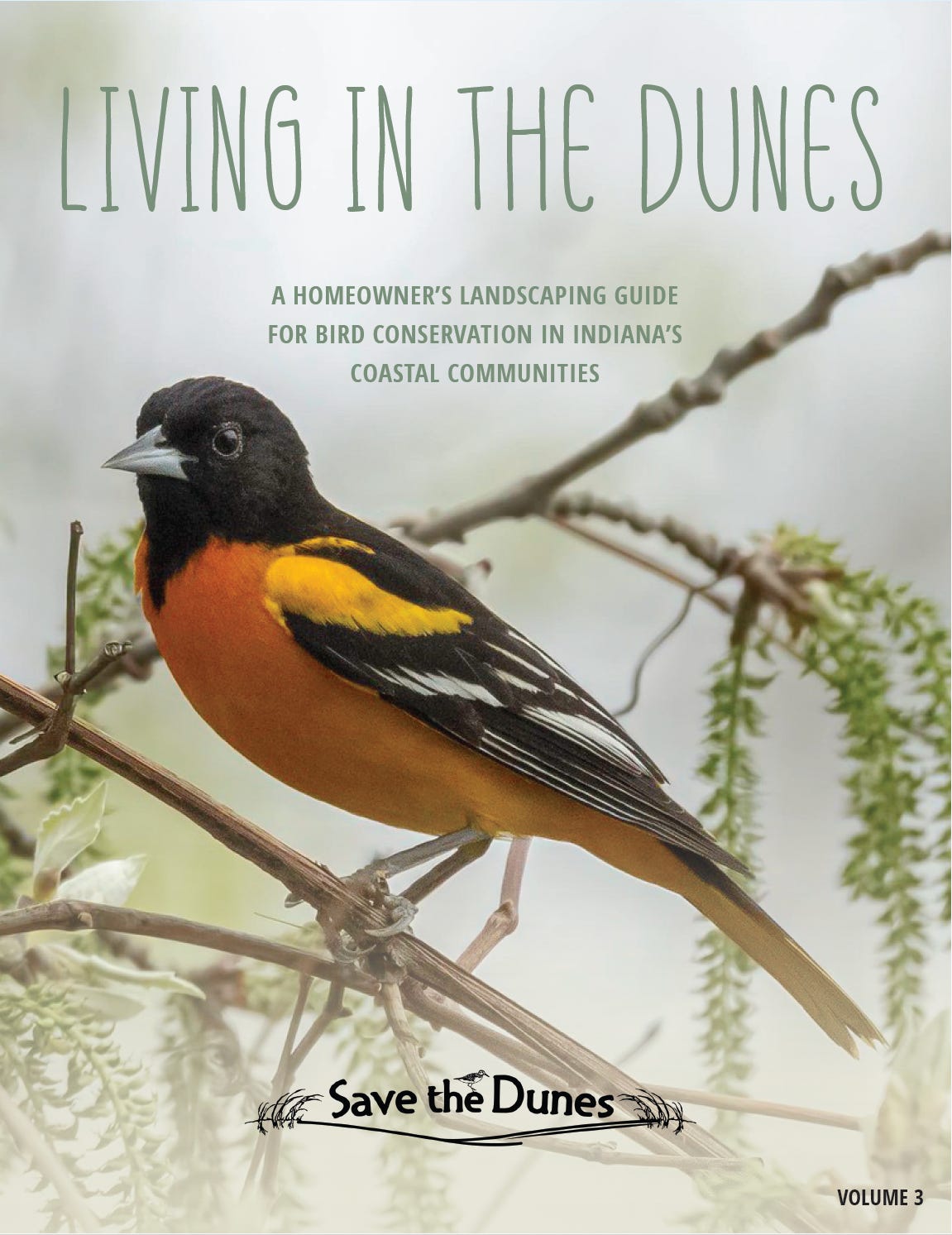
New garden guide for native plants welcomes birds home
As spring migration begins, the advocacy group Save the Dunes has published a free guide to planning a native garden that will attract and benefit native birds.
The online guide, in PDF format, provides concise guidance for gardeners on 20 birds and 20 native plants, while adding a wider perspective on how to fit them into a healthy ecosystem. Short sidebars cover cats, sandhill cranes, oak trees, light pollution and other elements.
The guide focuses on the three northwest Indiana counties where the Indiana Dunes are found, but it can generally be used across northern Indiana and southwest Michigan.
The idea is to fill in the gaps along birds’ travel routes. We gardeners can provide bits of food, shelter and safety for birds between and around the dunes and other local preserves, so they can cross the vast landscapes where native ecosystems have been lost and severely fragmented from farming and development.
“Birds don’t recognize property lines, and conservation can’t stop at park boundaries,”
Program Director Katie Hobgood, who oversaw the guide project, quips. “Our protected lands form the foundation, but this guide shows how home gardens complete the mosaic birds depend on to move safely across our fragmented region.”
She spoke with me about what’s in the guide.
Here’s her top piece of advice:
“It’s really about your goals,” she says. “What are you trying to do?”
This is the third in a series of guides for gardening from Save the Dunes. The first volume came out in 2016, focusing on invasive plants and the native plants with which you can replace them. The second volume, out in 2021, guides gardeners on native plants to support pollinators.
All three have a similar design and approach, ripe with color and identifying photos.
In this last volume, you’ll find information under each bird on their size, habitat, food, nesting areas and fun facts.
Under each plant, there are growing tips and information on what they look like, how they benefit birds and which birds they attract.
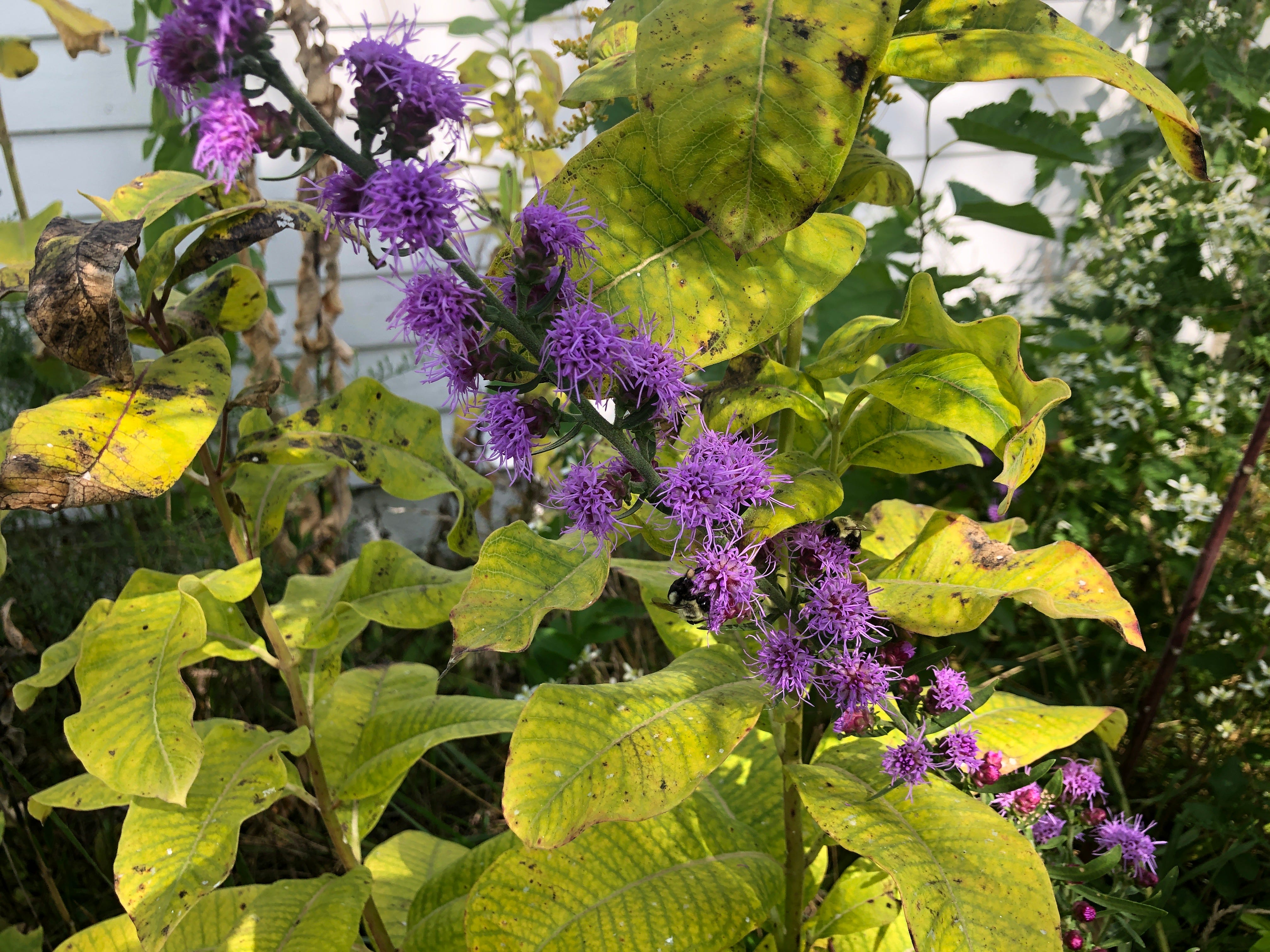
Why these 20 birds and 20 plants?
Hobgood admits that the “hardest part” in designing this product was narrowing it down to those 40 collective species — out of so many more. A committee of regional experts on birds, plants and ecology helped to advise such decisions.
As for the plants, she says they tried to avoid including species that are already covered in the first two guides. So, you’re really best off studying the first two guides, too. As she notes, most native plants help birds, though in varying ways. Some, for example, may host caterpillars, which birds could eat.
Unlike the prior two volumes, this guide includes trees and shrubs and explains the importance of layers of elevation in a native garden. Some critters need to be near the ground, while others need mid-level and higher places to hide and roost.
So, you’ll find paper birch and white pine trees, along with elderberry bush, among others, as well as some sedges, grasses and forbs.

As for the birds selected, Hobgood says they picked species that you’re likely to see in our general area if you have a native garden. They sought a good variety but also included some that are more fun to see or “charismatic,” like the American goldfinch and the Baltimore oriole, she says.
Can you use the guide outside of the dunes area?
Sure. The guide does focus on LaPorte, Porter and Lake counties — the home of the Indiana Dunes — but it also generally can serve any of the counties through northern Indiana and southwest Michigan, Hobgood says.
But she offers this bit of advice if you live outside of those three core counties: Before you go ahead with a certain plant, do a quick Internet search to ensure that it’s native to your county. If it’s not, it wouldn’t be a harmful plant, but it may not be the most appropriate or helpful for what you’re trying to do.
Where to find the garden guides
Find all three gardening guides at savedunes.org/resources, plus other fact sheets about the dunes.
Free printed versions of the guides are available at Save the Dunes headquarters, 444 Barker Road in Michigan City, Indiana. Printed versions of the last two volumes can also be found at the Indiana Dunes Visitor Center in Chesterton and at the Indiana Dunes State Park’s nature center.
Online talk about the guide
Hobgood will discuss the guide and how it can be used in an online discussion, on Zoom, from noon to 1 p.m. Central time on Monday, March 9. Find that program and a link for registration at savedunes.org/events.
Wild Ones book on native plants
Meanwhile, watch for a colorful, illustrated and helpful local book for gardeners this spring. The South Bend chapter of Wild Ones has announced that this project, by key members, should be released in April 2026.
Watch my blog for more details on “Wild Plants for Michiana: Planting with Nature and Beauty in Mind.”
It should be a good one. I’ve known about it for several months as local experts worked to raise money and carefully develop its content and design.
And drop into Wild Ones’ monthly meetings at South Bend’s Pinhook Park, where you’ll learn from different local experts as they speak about native plants. Find details at southbend.wildones.org.
Doug Tallamy to speak in LaPorte
There’s another chance to hear from a national guru on native plants, entomologist Doug Tallamy, on March 28.
Tallamy has become sort of a rock star for native plants, without all of the flash. He’s started a movement, Homegrown National Park, where he advocates that each one of us can grow enough native landscape to collectively make a national park — a way to recoup the massive amounts of habitat and wildlife that we’ve lost to development and agriculture.
The University of Delaware professor spoke to more than 300 eager people from the community in September 2024 at the University of Notre Dame. I covered it for the South Bend Tribune, and it was packed with insight and information.
This time, the La Porte County Master Gardeners will host him in a free presentation from 10:30 a.m. to noon Central time March 28 in the La Porte Civic Auditorium, 1001 Ridge St., LaPorte, Indiana. He’ll again share insights on how to “save nature in your yard.”
Register at this eventbrite.com link.
Contact writer Joseph Dits at josephdits@gmail.com.
Feel like you’re getting more than you’re paying for from Joe? Your one-time tip would be beyond your subscription. Any amount is deeply appreciated. You truly rock!